“Axios?!” or “Axios!”: Who Is Now Worthy of Honor and Glory in Today’s Russian Orthodox Church?
Editor’s note.
We wanted to illustrate this story with a photograph of the award ceremony—and came across a curious detail. The Order of Glory and Honor, First Class, is Kadyrov’s first major award from the Russian Orthodox Church, while the Patriarchate’s official statement merely says that he was to be “awarded” the order and makes no mention of any in-person ceremony. Meanwhile, images have appeared online showing the Patriarch personally pinning a decoration on Kadyrov—for example, in posts by *Yeni Şafak* and *Terciman Media*. Yet the orders shown in these “photographs” are different from one another, and neither matches the Order of Glory and Honor, First Class. It appears that the missing ceremony was simply drawn in.
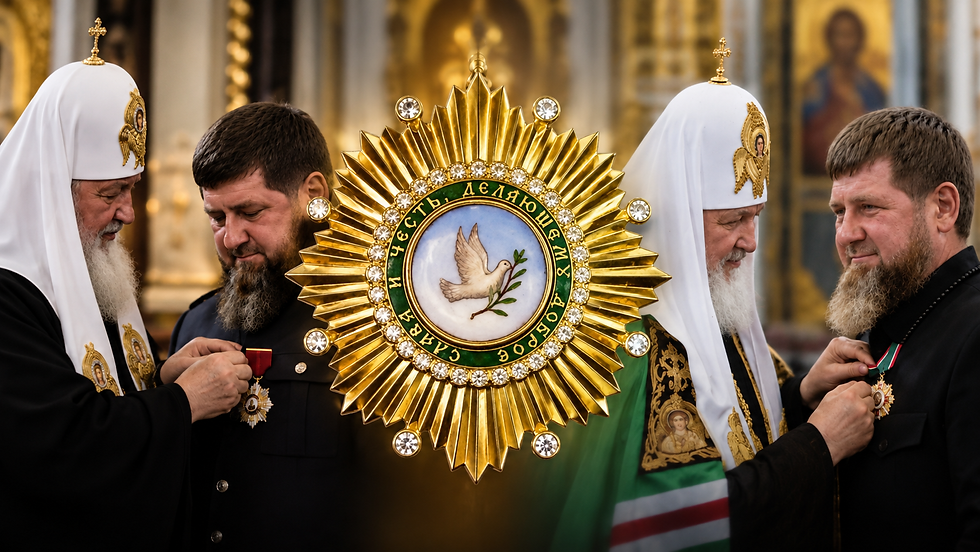
On October 5, for his 50th birthday, Ramzan Kadyrov received from Patriarch Kirill the Order of Glory and Honor, First Class, with the following citation: “You have proven yourself to be a strong-willed, purposeful, and responsible leader.” One immediately recalls the old joke about the pessimist who says things cannot possibly get any worse, only for the optimist to reply: “Oh yes they can! Yes they can!”
Over the years of war, His Sparrowship has accumulated no shortage of theological and moral “falls.” High on my personal list are the prayer for victory he composed and made obligatory; the sermon in which he spoke with unmistakable delight about the monastery of St. Seraphim of Sarov having been handed over in the Soviet era for nuclear weapons research; and the “witty” dressing-down—reeking of chauvinism, nationalism, and the heresy of ethnophyletism—of a priest from Mozhaysk at a diocesan assembly for criticizing the “patriotic tendencies” of the Russian Orthodox Church.
And if the original support for the war and the “Party line” could still, at a stretch, be explained by the Church’s dependent relationship with the state, everything listed above—and now the awarding, on October 5, of the Order of “Glory and Honor” (!!), First Class (!!!), to Kadyrov (!!!!)—brings to mind the famous line from Yevgeny Schwartz’s "The Dragon": “They taught everyone that way—but why did you have to become the best pupil, you bastard?”
Formally, of course, everything is perfectly explicable. The order is intended for public and state figures who have contributed to interreligious cooperation, peace, and friendship among peoples. In congratulating the head of Chechnya on his 50th birthday, the Patriarch described him as “a strong-willed, purposeful, and responsible leader,” emphasizing the republic’s achievements in security, socio-economic development, interreligious peace, and civic harmony. So what is there to discuss? The Church thanks a regional leader for his cooperation, and he receives a church decoration. A routine institutional procedure.
Except that an order—and especially a church order—is not a thank-you note, not a diplomatic gesture, not a ceremonial bouquet, not a birthday card or congratulatory telegram. It is a public recognition of honor, an ecclesial panegyric.
Why “ecclesial”? Because according to the canons—at least when this suits those at the top—the Patriarch is called first among equals. His recognition therefore becomes, in practice, recognition in the name of the fullness of the Church, even if the Church community itself does not share it and merely acquiesces in silence. And so, in the person of Kirill, the Church, by conferring such an order, does not simply say, “Thank you for what you have done.” It declares, loudly enough for more than just the Church—and more than just our contemporaries—to hear: “We consider you worthy of special respect and honor. And you, dear brothers and sisters, look, learn, and take as your example this man who now occupies the highest rank of honor.”
That is precisely why I cannot be reassured by the formal explanation that “Kadyrov was honored for interreligious peace” or “for long service.” Decorations of this kind are not bestowed on an isolated action detached from the person who performed it. If this were exclusively about one particular merit, it would be enough to present a formal letter under seal and say: “Thank you for promoting interreligious peace.” But an order is always a public pedagogical gesture: alongside recognition of a specific service, it inevitably elevates the public stature of the recipient himself.
It is not for nothing that, by tradition, a bishop—and a Patriarch is the presiding bishop—asks the people of God: “Worthy?” ("Axios?" in Greek), and waits for the affirmative response: “Axios! Axios! Axios!”
What interests me in this story is not so much Kadyrov himself as the system of coordinates in which such a gesture becomes natural.
The problem is not that the Church is capable of thanking a representative of state authority. On the contrary, it would be strange not to thank someone who genuinely helps Orthodox Christians live in peace, pray, build churches, raise their children, and confess their faith. All the more so in a Muslim-majority region, where the very possibility of peaceful coexistence between different religious communities truly matters.
One can thank a person for doing something good without thereby proclaiming that person an exemplar of virtue. One can say to an official: “Thank you for helping the parish.” One can say to a Muslim leader: “Thank you for defending the right of Orthodox Christians to live in peace.” One can even present a commemorative token as a sign of gratitude.
But when the Church gives someone the Order of Glory and Honor, it no longer merely records a useful act. It incorporates the recipient into its own symbolic system of values. An award always produces a public effect and creates reputational capital. Without words, it says: “Here stands a man with a complicated biography, but within our moral universe he belongs among those whom we deem worthy of particular honor.”
And this is where the question arises that cannot be dismissed by appealing to protocol: what exactly does the Church declare worthy of glory and honor through this gesture?
Administrative efficiency? Political stability? The ability to maintain order? Personal strength? Loyalty to the institution of power?
Or is it, after all, that form of human dignity which the Gospel associates first and foremost with love, mercy, peacemaking, wise service, and responsibility not so much before one’s superiors as before God—and, in Kadyrov’s case, before God as understood within another religious tradition—and before one’s fellow human beings?
These things may coincide. They do not have to.
A person can be an excellent administrator and a bad Christian—or Muslim. He can be a strong political leader and at the same time a man whose actions raise grave moral questions. He can ensure stability through bloodthirsty and barbaric methods of violence and the suppression of dissent. State effectiveness and Christian virtue are not synonyms.
A state assessment—issued by a state that is, according to the Constitution, separate from any religious organization—may well read: strong-willed, purposeful, responsible, effective in governing his region. But a church assessment would have to ask more: How does this man treat the weak? What happens to those who disagree with him? How does he treat his enemy? How does he treat someone who has no power? What does he do with his own strength? Is he capable of stopping at the point where reasons of state no longer justify human suffering?
In a church context, “strong-willed, purposeful, and responsible” is simply not enough.
More than that: these very qualities can become terrifying when they are not subjected to moral judgment. A strong-willed man may be cruel. A purposeful man may be fanatical. Someone responsible before the system may be utterly irresponsible before ordinary human beings. A powerful leader may turn the weak into material for the achievement of his own goals—or for compensating for his complexes, guilt, resentments, and whatever else.
Orders, moreover, are part of the Church’s symbolic language. And this language is read not only by Kadyrov and the Patriarch. It is read by millions of people: those who have watched Kadyrov’s history unfold since 2000; journalists who have been threatened with violence—and not merely threatened; people for whom the name Nemtsov is inseparable from murder, and the name of "Novaya Gazeta", now designated a “foreign agent,” from a decades-long struggle for the right to speak the truth; those who have heard Kadyrov’s bellicose and dehumanizing rhetoric about Russia’s enemies.
And all of them read the same, perfectly unambiguous symbolic gesture: the Church bestows upon this man the Order of Glory and Honor, without regard for the pain or judgment of a great many people.
It is worth recalling that in the early Church, even a single cry of “Anaxios!”—“Unworthy!”—from among the people could be enough to interrupt an ordination or the conferral of a church honor. By acts such as this one, the Patriarch and the episcopate pointedly and deliberately emphasize the distance between themselves and the plebs—the laity.
It matters especially that the order is called precisely the Order of **Glory and Honor**—and First Class, no less. Its motto is taken from the Apostle Paul: “Glory, honor, and peace for everyone who does good.”
Let me stamp the words as one stamps an order itself: not to the strong, not to the victorious, not to the effective manager and administrator, not to the loyal and obedient executor of another’s will, not to the one who secures stability by fire and sword—but to "the one who does good", that is, the one who thinks and acts in the categories of the Good. Not merely private good, but the common good.
Christian honor, in fact, is arranged in a rather strange way by the standards of this world. Christ proposes that greatness be measured not by how many people you can force to obey you and sing your praises, but by how many you are capable of serving with your vocation, gifts, position, abilities, and everything else: “Whoever wants to be first among you must be slave of all.”
The Gospel does not abolish strength. It subjects strength to an entirely different test: what do you do with your power once you possess it?
His Sparrowship, whether deliberately—in which case this is an outright offense against the Church community—or unintentionally—in which case it is evidence of feeble-mindedness and theological obtuseness—effortlessly mixes and shakes together a “cocktail of Christian honor” made from three entirely different ingredients: political effectiveness + loyalty to the state + Christian virtue.
These qualities can, of course, coexist in one person. They do not thereby become identical.
And once church language begins to employ state criteria for judging a human being, a very dangerous substitution takes place. Moral coordinates begin to blur, and the compass of the Church—the ship of salvation—starts to resemble Captain Jack Sparrow’s compass: whatever serves the state system begins to be perceived as self-evidently Good in itself.
Stability becomes almost synonymous with peace; order with justice; manageability with responsibility; strength with dignity.
Yet anyone who reads the Gospel attentively and knows the Bible will notice that throughout Scripture, God is forever frustrating humanity’s attempts to arrange the world in precisely this way.
The problem is not that the Church saw something good in Kadyrov. The problem is that, having seen something good, it chose to honor it with specifically ecclesial honor in a man whose public figure is inseparably bound up with a whole series of grave moral and political questions.
And what troubles me even more than Kadyrov himself is the ecclesial mirror in which the Church begins to show power its own reflection. In that reflection, power—whatever decisions it makes, whatever actions it takes—always appears worthy, strong, responsible, and deserving of honor.
Perhaps no one is consciously substituting anything for anything else. Perhaps everyone sincerely believes that this is exclusively about interreligious peace and civic harmony. But institutional deformation begins precisely not where someone consciously lies, but where a system gradually loses the ability to notice distinctions between categories that once seemed obvious.
I have written before—and forgive me for quoting myself—that one of the greatest dangers to the Church lies not so much in any particular bad government as in the very idea of the “institution”: an impersonal system to which a person gradually hands over his freedom and responsibility.
An institution is initially necessary: without form, neither continuity nor order is possible. But every structure, once it ceases to be warmed by a relationship to and with the human person, begins to defend and serve not life and its sacredness, but itself, turning the person into a function and relationship into procedure.
And here a paradox emerges. The Church may remain formally free: no one forbids it to preach Christ, celebrate the Liturgy, build churches, or confer honors. And yet inwardly it may become dependent on the very system it is called to judge from an evangelical distance and measure by an evangelical “ruler”—in Greek, a *canon*.
The most subtle form of the Church’s unfreedom begins not when the state forbids it to speak, but when the Church becomes so accustomed to standing beside power that it gradually begins to see the world through the eyes of power.
And then the first among equals—with the silent acquiescence of those “equals”—begins to conduct a public moral selection. From the morally contradictory, ethically compromised entirety of a particular human being, he—and, with him, once again, the Church—selects certain qualities, places them within the frame of a church decoration, and thereby invites society to look at that person only through this frame.
Let us say it plainly: the Church, and no one acting in its name, has the right to polish and buff anyone’s biography so readily in accordance with the political moment.
Christianity is, after all, profoundly incompatible with this kind of editing.
Christ does not look at a person as a collection of useful functions. He does not say: “This part of you suits Me; that part we shall leave outside the frame for now.”
The Gospel restores, nurtures, and calls forth human wholeness. That is precisely why a Christian judgment of a person is always more complex than a state assessment—or any other kind of official characterization.
And so, in the end, one question remains, and it is the hardest to brush aside: does the Church still possess a vision of its own?
Is it still capable of seeing a person whole—with all his complexity, contradictions, good and evil—or is it satisfied with that portion of the portrait which looks good among trophies and medals, beside an equally immaculate portrait of the Leader?
Does the people of the Church still have any possibility of objection when the question “Axios?” is asked—or is silent and unquestioning assent all that remains?
Regrettably, one must conclude that the cry of “Axios” has finally been transformed from a question into a directive declaration.
And the most disturbing thing is not even that the answer turned out to be affirmative.
It is that the question addressed to the Church no longer truly exists.
Abba Myron the Unarmed

Comments